Mattel's
My Child Dolls
🚧 Pardon the dust 🚧 I'm finally re-working the entire site.
History
Here you will find the history of My Child dolls along with a timeline.
Overview
Mattel’s My Children collection was copyrighted in 1985 with commercial production beginning in 1986 and continuing through 1988. Though My Child dolls were produced for only a few years, the line changed significantly during that period.
Manufacturing moved from Taiwan to China, the line expanded beyond North America, international dolls received new hairstyles and a warmer skin tone, and the final years brought distinctly different approaches for the North American and global markets.

Copyright and Production / Marketing Timeline
Understanding this production timeline will help in identifying and dating My Child dolls today. Since both Taiwan-made and China-made dolls are associated with 1985, so manufacturing details, not just the copyright year, are important for identification.
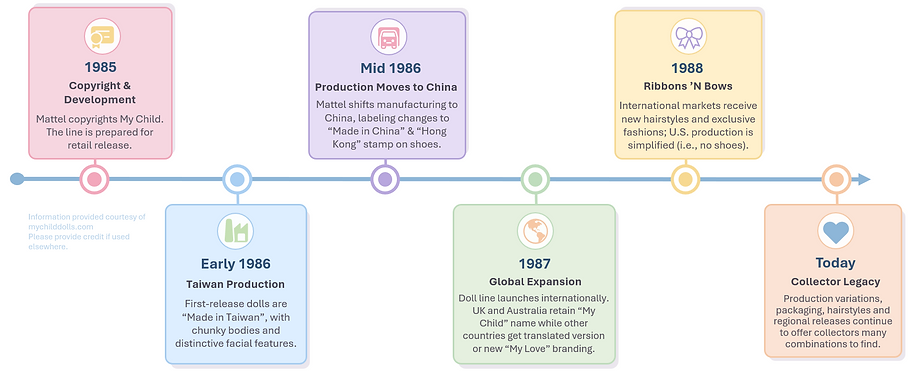
1985: Development and Copyright
Mattel designed My Child as a soft-bodied toddler doll with a velvety fabric-covered face, inset eyes, rooted hair, rounded cheeks, and a soft, childlike appearance. The combination of a plush body and detailed face gave the dolls a look quite different from traditional hard-vinyl dolls of the period (i.e. Cabbage Patch dolls, Bottle Time Baby, Baby Bunting Beans, Baby Kickie, etc).
My Child dolls carry a 1985 Mattel copyright, although the dolls were released commercially beginning in 1986. Mattel's copyright filings document the text "MY CHILD" was first used on Sep. 30, 1985 and the logo was first used on Jan. 31, 1986.
Thus, the 1985 date should be understood as the beginning of the line’s development and copyright history rather than the primary retail release year.

My Child Logo (© cancelled: Apr. 26, 1993)

Close-up of copyright tag on 1987 doll
Excerpt from Mattel's corporate site:
This lifelike doll has bright eyes, soft skin and loves to pose in many ways. And because there are thousands of different children in the My Children collection, there's a special one for every little parent. This innovative doll has many unusual characteristics. These include a neck that can move in all directions, charismatic eyes and skin so appealing, we call it "Skin So Soft". In addition, My Child is poseable and has hair that can be brushed and styled. All this adds to the realism of this lovable doll and makes a kid feel more like a parent.
1986: First Production in Taiwan
My Child dolls were first manufactured in Taiwan. The toy line offered girls and boys in in white (pale peach) or black skin (Note: skin tone naming is from Dealer catalogs). They were offered in several hairstyles and outfits creating numerous styling combinations. Unlike cabbage dolls, My child dolls did not come with a name. Instead they came with locket mail order offering. This locket came with several stock images of dolls that one could choose appeared most like their doll and place in the heart locket and a booklet where one could write the doll's "name."

Mail-in Locket Offer
"Made in Taiwan" doll
Early-1986 Identification
Taiwan dolls, their shoes, and packaging are all labeled as "Made in Taiwan". Their shoes will have the word “Taiwan” molded into the back heel or the center of the sole. While original box packaging and paperwork will also state "Made in Taiwan".
The dolls themselves have a number of characteristics that collectors can use to identify them if their label has been cut or torn off from play.
Doll features include:
-
fuller, chunkier bodies (more stuffing in arms, legs, torso)
-
facial features**:
-
Facial sagging (this creates a distinctive sad or frowny appearance)
-
Protruding eyes (while some China doll eyes also may not be flush with skin, Taiwan doll eyes protrude quite a bit)
-
Slightly rounder faces
-
Very rosy cheeks
-
Relatively short eyelashes
-
Slightly puckered or “kissy” lips due to facial sag
-
Close-up of Taiwan shoe markings
Taiwan packaging showing manufacture
** Note: Over time, the facial coloring on these dolls commonly fades away giving them a bit of blank face.
These physical differences are especially noticeable when an early Taiwan doll is placed beside a later China-produced doll.

Taiwan and China dolls side by side
Mid-1986: Production Moves to China
During 1986, Mattel moved My Child production from Taiwan to China. With the factory changes, China-made dolls now more closely follow Mattel's artwork of My Child dolls. Thus several changes can be seen in body construction, facial shape, and the way the dolls aged over time.
Additionally, a new Hispanic skin tone was added to the doll line up. Meaning Mattel now offered girl and boy dolls in White (pale peach), Black, and Hispanic (Note: skin tone naming is from Dealer catalogs).
Black and Hispanic dolls each have unique hairstyles.
For Black dolls, the girls had curly pigtails and the boys had curly short hair with no hair part. For Hispanic dolls, the girls had a medium length, mid-part hairstyle with bangs and the boys had curly short hair with no hair part. [See Dolls -> Hairstyles for more info]
When searching aftermarket sites for these dolls, it's important to note that most are sold using the copyright date of 1985. However, while all of the dolls have © 1985, they have been produced in two different manufacturing countries and thus will have different aesthetics and quality of materials.
"Made in China" doll
Mid-1986 Identification
China dolls, their accessories, and packaging are all labeled as "Made in China". Their shoes will have the words “Hong Kong” molded into the back heel or the center of the sole (if you find shoes with "China" on them, they are not from the My Child line but from 90's Magic Nursery toy line that reused the My Child shoe mold). Original box packaging and paperwork will also state "Made in China".
Aside from manufacturing markings, packaging, and shoes, there are several clues that can assist in identifying a China-made dolls, including:
-
Slimmer body proportions
-
Facial features:
-
Less prone to facial sagging (usually little to none, with the exception of dolls released in Australia)
-
Little to no eye protrusion (eyes sit flush with face)
-
More of a pear-shaped face
-
Moderate to light rosy cheeks
-
Longer eyelashes
-
More defined lip shape
-
Close-up of "Hong Kong" shoe markings
China packaging showing manufacture
1987: My Child Goes Global
In 1987, production continued in China and Mattel expanded doll sales beyond North America. The dolls continued to be sold in the U.S. and Canada, while Mattel also launched the collection in several international markets.
U.S. dolls saw no notable differences in 1987 minus packaging (i.e., cellophane was added to the front of their box to protect the dolls). Globally, the doll's appearance and hairstyle options changed along with new packaging theme and branding.
In English-speaking markets such as the Canada, United Kingdom and Australia, the dolls continued to use the familiar My Child name. However in several European countries, Mattel localized the branding. The UK and European countries all got new packaging, a cream colored box with pink daisy motifs and art depicting the dolls climbing all over the box. U.S., Canada, and Australia packaging remained purple with paint swipes of pink and aqua around the box. Oddly, Australia and Canada ended up with the 1986 U.S. box style (sans cellphone and My Child logo splashed across the bottom of the box).
As such the packaging as labeled as follows:
-
U.S.A: My Child
-
Canada: My Child | Mon' Enfant
-
Germany: Mein Kind
-
Italy: My Love, Amor Mio
-
France: Mon' Enfant de Mattel
-
The Netherlands and Belgium: Mijn Kleintje
-
United Kingdom: My Child
-
Australia: My Child
1987 U.S. Box

Example of global branding around doll outfit package
1987 Identification
In the U.S., 1987 dolls did not change, no new hairstyles or skin tone adjustments. Only the packaging was updated, adding cellophane to protect the dolls from grabby hands.
For the rest of the world, international dolls developed a noticeably different appearance along with acquiring a few new hairstyles. However international markets did not get Hispanic or Black skin tone dolls (they were only ever sold in U.S. market).
The most recognizable differences for international dolls was their skin tone which changed to a warmer, peachier complexion. While not always noticeable in photos, the skin tone different can look almost suntanned beside the pale peach, almost white, skin tone of U.S. dolls.
1987 exclusive hairstyles included:
-
Double ribbons (DR) short ponytails with curly fringe/bangs (similar to US DRs however
-
Ringlet ponytails (RP) with curly fringe/bangs
-
V-Part (VP) large curl Fringe/Bangs with medium length wavy hair
-
Ultra long (UL) ponytails in braids with straight fringe/bangs
-
Ultra long (UL) braided ponytails with straight fringe/bangs
Peach skin tone VS pale US skin tone.
Gallery of 1987 hairstyles
1988: My Child Goes Two Directions
In 1988, production continued in China and Mattel continued global doll sales. However the doll line took a divisive turn. The U.S. lineup took cost cutting measures, mostly likely due to lack of popularity, while international lineup expanded in and effort to increase popularity.
U.S. Market
In the U.S. release, the doll line became more economical, with:
-
Smaller pink trapezoid packaging
-
Reduced accessories (meaning no more bears or booklets with outfits)
-
No shoes included (had to be purchased separately)
-
Some minor outfit revisions (pinafore apron closes via Velcro instead of fabric ties)
International Market
In the international market, Mattel updated the dolls appearance with the introduction of the "Ribbons ’N Bows" line (this line was not available in U.S. or Canada but due to collectors over 40 years buying internationally, you can now find them in in North America).
The packaging prominently promoted the theme: “With hair ribbons & bows for you & your doll!” and packaging was updated to include the "Ribbons ’N Bows" heart logo.
As such the packaging as labeled as follows:
-
U.S.A: My Child
-
Canada: My Child | Mon' Enfant
-
Germany: Mein Kind – Schleifchenmoden
-
Italy: My Love, Amor Mio – Nastri e Fiocchi
-
France: Mon Enfant de Mattel – Rubans et Noeuds
-
Netherlands/Belgium: Mijn Kleintje – Haarlinten en Strikjes
-
United Kingdom: My Child - Ribbons 'N Bows
-
Australia: My Child - Ribbons 'N Bows
Ribbons ’N Bows line included:
-
1988-exclusive hairstyles and a few revised 1987-exclusive hairstyles
-
10 exclusive fashion designs that came with:
-
matching hair accessories
-
coordinating socks or stockings
-
color-matched T-bar shoes
-
For more information see respective pages on Hairstyles and Outfits.
1988 U.S. Box
Ribbons 'N Bows branding
1988 Identification
In the U.S., 1987 dolls did not change, no new hairstyles or skin tone adjustments. Only the packaging was updated, adding cellophane to protect the dolls from grabby hands.
For the rest of the world, international dolls acquired additional long hairstyles and outfits as part of the Ribbons 'N Bows lineup. However international markets still did not get Hispanic or Black dolls (they were only ever sold in U.S. market).
1988 exclusive RnB hairstyles included:
-
Mid-part (MP) long ringlet hair with curly fringe/bangs
-
Mid-part (MP) long crimp hair with curly fringe/bangs
-
Side-Part (SP) long ringlet hair sans fringe/bangs
-
Ultra long (UL) braided ponytails with curly fringe/bangs

1988 Outfits and Hairstyles (promotional photo shows prototype O's and /'s dress which was never released)
1988 exclusive RnB outfits [Additional information on Girl Outfits page]:
-
Floral flare dress with yellow tulip motif
-
Pink & white stripe flare dress with pink tulip motif
-
Blue with white hearts pinafore (aka blue hearts pinafore)
-
Floral pink & blue flowers and mint color leaves pinafore (aka mint & pink floral pinafore)
-
Pink romper with pinafore
-
Yellow romper with pinafore
-
ABC dress
-
Prototype of this outfit was originally a confetti-style dress with O's and /'s but when produced the fabric was changed to ABC fabric.
-
-
Purple Floral ABC-style dress
-
Black gingham school dress
-
Red & blue plaid school dress
-
Shortly after release, pattern changed to Red Gingham school dress so the red & blue plaid is consider harder to find.
-